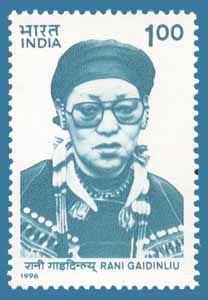
 Born to mother Kerotlenliu and father Lothuanang on January 26, 1915 at Lungkao village in Tamenglong district of Manipur, Rani Gaidinliu was a very different person from the very childhood. She was affectionate, hardworking, obedient and very talented, always curious to learn.
 Her exploratory mindset, love for religion, culture and the country drew her closer to fierce revolutionary and spiritual leader—Haipou Jadonang of Kambiron village.
Her association with Haipou sparked the inherent energy already in her and she became his lieutenant. But the British rulers had some other plan. They implicated Jadonang in a false murder case and hanged him in Imphal jail on August 29, 1931.
As a wounded lioness she was gnawing her teeth against the British rulers. There was a fierce fight in 1932 between the Rani and the British army at Hungrum village in Assam. The British declared her as the “terror of northeast” and announced a reward of Rs 500/- on her head to catch her live or dead.
She was surrounded from all corners in a pre-dawn fight in Poilwa village and was put in jail for life. After fourteen years of jail term from 1934 to 1948, she was released from Shillong jail and camped in Yimrup village in Tuensang district. But she went underground again in 1956 and resumed her fight for preserving her religion and culture.
On being approached from the state Government she responded positively and under an agreement she submitted her arms to Government and started leading a life of social reformer and spiritual awakener in 1966.
She was given a Government accommodation, a freedom fighter’s pension, security guards, a Government Personal Assistant (PA), two maid-attendants, a vehicle along with driver and journey expenditures. Rani Gaidinliu was of the view that culture and religion of Naga society was in peril.
She used to arrange threads of nylon and cotton, for preparing customary Naga costumes. The Heraka training camps were organised to teach weaving of customary garments, practice of folk songs, Heraka songs and dances.
New formations of dances were evolved. Traditional musical instruments were played, competitions in traditional games and wrestling were organised and customary dress competitions were held for boys and girls separately, sea-shells and glass-beads were sold at cheaper prices to participants preparing traditional dresses. Rani Ma was a saint poetess.
She composed hundreds of devotional and patriotic songs. She has also composed a number of songs sung individually and in groups. These songs are for various occasions like festivals, marriage ceremony and death rituals, etc.
The visit of Rani Ma in any Naga area used to spread like wildfire and people—Christians and Hindus (non-Christians) both used to come out on the road to have a darshan of her. She would stop at gathering at prominent places, meet the people, exchange the good-wishes and then advance on journey.
The Hindu society worshipped her like a Goddess. She toured the country extensively. She met the second RSS Sarsanghachalak MS Golwalkar (Guruji) in early seventies at Guwahati, attended the Second World Hindu Conference 1979 at Prayagraj (Allahabad) at Sangam (convergence) during one and quarter month long Maagh Mela.
She graced the World Women Conference as its President where the lady dignitaries from all over the country and abroad had assembled. Since then, she had close association with a number of dignitaries and organisations throughout the country. She became a bridge between Naga society and larger Hindu Samaj.
For the selfless service to the society and the country she was conferred a number of awards. They are:-
- Freedom Fighter Tamrapatra Award 1972 by Prime Minister Indira Gandhi.
- Padma Bhushan 1982 by President Neelam Sanjiva Reddy.
- Vivekananda Sewa Samman 1983 by Bada Bazar Kumarsabha Pustakalaya, Kolkata.
- Birsa Munda Award, 1996 (Posthumous)
Rupees one lakh in cash and a citation is given to winners of this award. A postal stamp has also been released in her memory.